In this article
The job description has not changed. The job has.
If you are leading marketing in an asset management company today and your days are still organised around campaign calendars, creative reviews, and quarterly brand trackers — you are doing the job that existed three years ago. The role that exists now is fundamentally different. And the gap between the two is widening faster than most CMOs in financial services are prepared to acknowledge.
This is not a criticism. It is a warning. Because the CMOs who recognise the shift and move deliberately will define what marketing leadership looks like in asset management for the next decade. The ones who do not will find themselves increasingly peripheral to the strategic conversations that matter most in their organisations.
The mandate has changed. The question is whether you have.
What the old mandate looked like
For most of the last two decades, the CMO mandate in asset management was reasonably well defined. Build the brand. Support distribution. Manage the communications calendar. Keep compliance happy. Deliver campaigns on time and on budget. Measure reach, recall, and engagement. Report to the MD or CEO on brand health and marketing ROI.
It was a support function with strategic ambitions. Occasionally it had a seat at the table where real business decisions were made. More often it was brought in after those decisions to communicate them effectively.
The best CMOs in asset management made the most of that mandate. They built brands that distributors trusted and investors recognised. They created communication frameworks that held up across market cycles. They managed the tension between commercial pressure and brand integrity with skill and patience.
That work mattered. It still matters. But it is no longer enough.
What changed
Three forces converged to redefine the CMO mandate — and they did not arrive one at a time.
AI entered the marketing function. Not as a future possibility but as a present operational reality. Content production, campaign personalisation, investor segmentation, distributor enablement, market intelligence — AI has a productive role in every one of these areas right now. The CMO who understands how to deploy AI strategically across the marketing function has a capability advantage that compounds over time. The CMO who delegates AI to a junior digital team and checks in quarterly does not.
The investor relationship shifted. Direct investing grew. Digital touchpoints multiplied. Investors began forming opinions about fund houses independently — through content, through peer networks, through their own research — before they ever spoke to a distributor. This means the CMO now has direct influence over investor acquisition and retention in a way that was simply not possible when the distributor owned the entire relationship. That influence is an opportunity. But it requires a fundamentally different approach to how marketing defines its role and measures its impact.
The board started asking different questions. Three years ago, a board asked the CMO about brand awareness scores and campaign performance. Today, the questions are different. What is our AI strategy? How are we building direct investor relationships at scale? What is marketing's contribution to AUM growth? These are not communications questions. They are business strategy questions. And they require a CMO who can answer them with the confidence and specificity of someone who has been in the room where those decisions are made — not someone who was briefed on them afterwards.
What the new mandate demands
The CMO mandate for 2026 requires four capabilities that were optional three years ago and are non-negotiable today.
Strategic AI literacy. Not technical expertise. Strategic literacy. The ability to understand what AI can and cannot do in a regulated marketing environment, where it creates genuine value versus where it creates compliance risk, and how to build governance frameworks that allow your team to move fast without moving recklessly. This is not a skill you can outsource or delegate. It is a leadership capability that the CMO must own personally — because every significant AI decision in the marketing function will ultimately require a CMO who can defend it to the board, to compliance, and to the regulator.
Data fluency. The modern AMC generates more investor data than any previous generation of marketing leaders had access to. That data is only valuable if the CMO knows how to read it, question it, and translate it into strategic decisions. Data fluency does not mean running your own analysis. It means knowing which questions to ask, which signals to trust, and which metrics actually matter versus which ones simply make the function look busy.
Cross-functional authority. The CMO mandate in 2026 extends well beyond the marketing department. Investor experience touches product, technology, operations, compliance, and distribution simultaneously. The CMO who can only lead within the boundaries of their own function will always be limited in their impact. The ones who build genuine authority across functions — who are trusted by the product team, respected by technology, and valued by distribution — are the ones who can drive the kind of integrated change that actually moves AUM.
A point of view on the business. This is perhaps the most underrated requirement of the new mandate. The CMO of 2026 needs to have a clear, informed, and defensible perspective on where the asset management industry is going — not just where marketing is going. That means understanding distribution dynamics, regulatory direction, competitive positioning, and investor behaviour at a level of depth that allows you to contribute meaningfully to business strategy conversations, not just marketing conversations.
The architect metaphor
The shift from campaign manager to AI architect is not about abandoning what made great CMOs great. Creativity, brand instinct, communication craft, the ability to simplify complexity — these capabilities are more valuable now than they have ever been, precisely because AI can produce volume but cannot produce judgement.
What the architect brings that the campaign manager does not is systems thinking. The ability to see how the parts connect. To understand that an investor communication strategy, a distributor enablement programme, an AI deployment framework, and a brand governance model are not separate workstreams — they are components of a single integrated system that either works together or undermines itself.
Building that system is the work of the CMO in 2026. It requires a broader set of relationships, a deeper understanding of technology, a more sophisticated grasp of data, and a more active presence in business strategy conversations than most marketing leaders in asset management have historically been asked to have.
It is more demanding. It is also more consequential.
The uncomfortable truth
Not every CMO who was excellent at the old mandate will thrive under the new one. That is not a failure of talent or intention. It is a function of how rapidly the requirements have shifted and how little of the professional development infrastructure for marketing leaders in financial services has kept pace with that shift.
The CMOs who will lead their organisations through the next five years are the ones who are honest with themselves about where their capabilities end and where they need to grow. Who are investing in that growth now — not waiting for their organisation to invest in it for them. Who understand that the mandate has changed and are building the skills, the relationships, and the strategic presence to meet it.
The campaign manager built the brand.
The AI architect will determine whether it survives — and leads — in the decade ahead.
The mandate is yours to define.
No board has written a job description for the CMO of 2026 in asset management. No industry body has published the framework. No business school has designed the curriculum.
Which means the CMOs who move now — who expand their mandate deliberately, build their AI literacy seriously, and show up to business strategy conversations with genuine authority — are the ones who will write the definition that everyone else follows.
That is not a small opportunity.
It is the most significant leadership moment the marketing function in asset management has ever had.
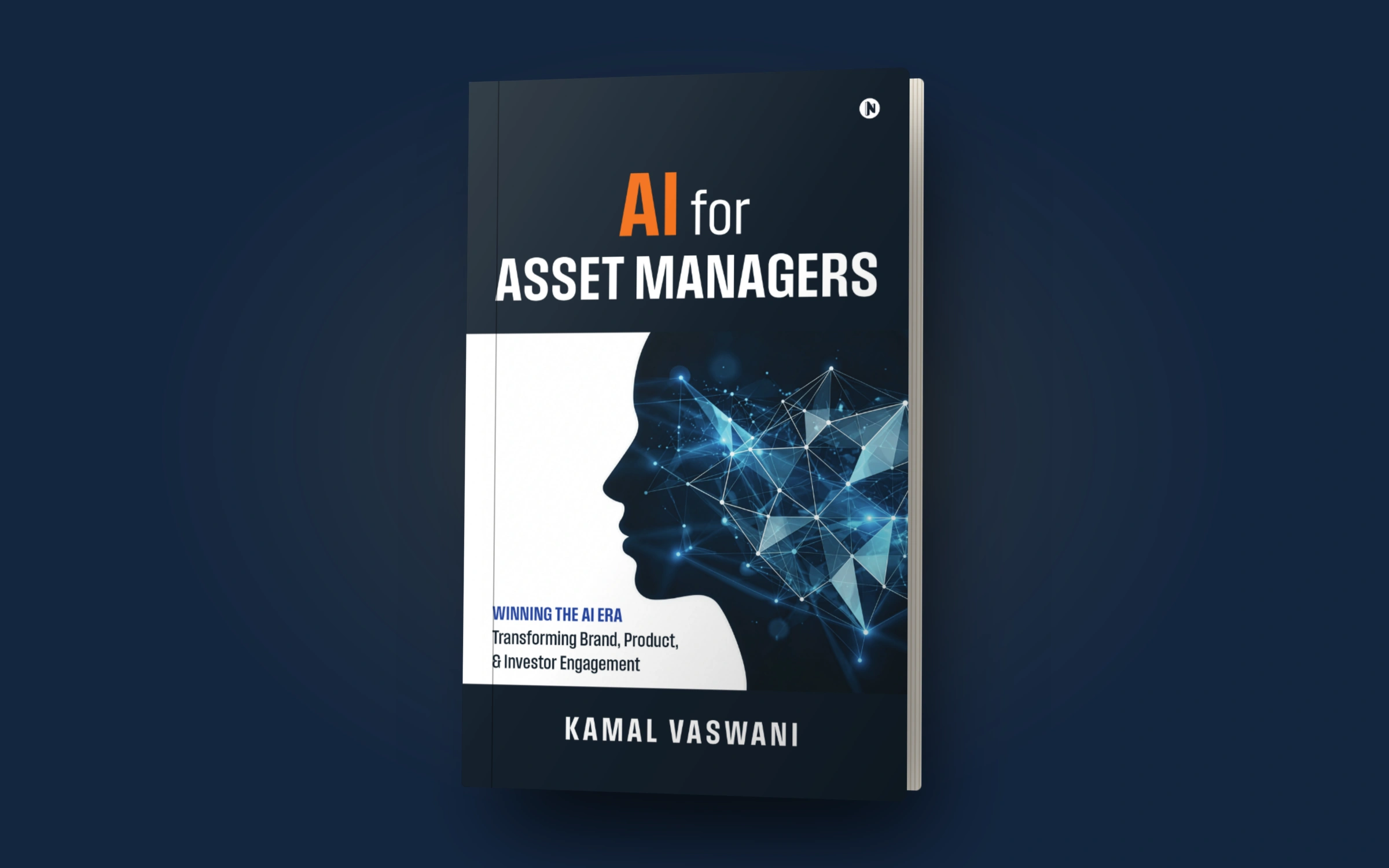
Kamal Vaswani is the author of AI for Asset Managers: Winning the AI Era, available on Amazon, Flipkart and Ingram. She is the founder of BYLAAR and the creator of the TRUST-AI™ framework.
 Written byKamal VaswaniFounder, BYLAAR · Author, AI for Asset Managers: Winning the AI Era