In this article
- Why compliance and AI feel like opposites — and why they are not
- What SEBI and AMFI actually govern in marketing
- The three compliance risks that AI introduces in fund marketing
- What a compliant AI deployment framework looks like in practice
- The competitive advantage hiding inside compliance
- The question every AMC CMO needs to answer
The most dangerous place to deploy AI in asset management is also the most tempting one.
Investor communication. Fund performance narratives. Distributor-facing content. Scheme information documents. These are the areas where AI can compress timelines, personalise at scale, and free your marketing team from work that consumes hours without adding strategic value. They are also the areas where a single compliance failure can cost your fund house its reputation, its distributor relationships, and its standing with the regulator — simultaneously.
This is the tension that every AMC CMO in India is navigating right now. And most are navigating it without a framework.
That is the problem this post is here to solve.
Why compliance and AI feel like opposites — and why they are not
There is a perception in asset management marketing circles that AI and compliance exist in permanent conflict. That speed and regulation cannot coexist. That the more you automate, the more you risk. That the safest approach to AI in a regulated marketing environment is to move slowly, experiment quietly, and wait for someone else to establish the precedent.
This perception is understandable. It is also strategically costly.
The AMCs that are winning the AI era are not the ones that chose between speed and compliance. They are the ones that built compliance into their AI deployment architecture from the beginning — so that speed and regulatory integrity reinforce each other rather than trade off against each other.
The difference between these two approaches is not technology. It is framework. It is the deliberate decision to treat SEBI and AMFI guidelines not as constraints on what AI can do in your marketing function, but as the design parameters within which your AI capability is built.
That reframe changes everything.
What SEBI and AMFI actually govern in marketing
Before any AMC can deploy AI responsibly in its marketing function, its leadership needs clarity on what the regulatory framework actually covers — and where it is silent.
SEBI's advertising code for mutual funds is specific about several things that are directly relevant to AI-generated content. Performance claims must be accurate, current, and presented with mandated disclosures. Risk communication must be prominent, not buried. Comparative advertising has clear boundaries. Testimonials and endorsements are governed. Scheme-specific communication must align with the scheme information document.
AMFI's guidelines layer additional requirements around distributor communication, investor education content, and the use of digital channels for fund marketing.
What neither framework currently addresses with specificity is AI-generated content itself. There is no SEBI circular that defines how an AMC should govern AI in its content production workflow. There is no AMFI guideline that distinguishes between human-written and AI-assisted investor communication.
This regulatory silence is not permission. It is a gap — and gaps in regulated industries have a consistent history of being filled by enforcement action when something goes wrong, rather than by proactive guidance before it does.
The AMCs that are building AI governance frameworks now — before the regulator makes them mandatory — are the ones that will be best positioned when the regulatory environment catches up with the technology.
The three compliance risks that AI introduces in fund marketing
Understanding where AI creates specific compliance exposure in an AMC marketing context is the first step toward managing it intelligently.
Accuracy risk. AI language models generate content based on pattern recognition, not factual verification. In fund marketing, where performance data, benchmark comparisons, and scheme-specific information must be accurate to the point of decimal places and current to the point of the last NAV update, AI-generated content that has not been verified against source data is a compliance liability. The risk is not that AI will deliberately produce inaccurate content. The risk is that it will produce plausible-sounding content that contains errors that a rushed review process misses.
The mitigation is not to avoid AI in performance communication. It is to build a workflow where AI generates the narrative structure and language while a defined verification step — human or automated against live data — confirms every factual claim before publication.
Disclosure risk. SEBI's advertising code requires specific disclosures in specific formats in specific locations within investor communication. AI that generates marketing content without being trained on these disclosure requirements will produce material that reads well but fails compliance review. The mitigation is to build disclosure requirements into the AI prompt architecture itself — so that every piece of content AI generates is structured around compliance requirements from the first draft, not retrofitted to meet them after the fact.
Consistency risk. One of the less-discussed compliance risks of AI in fund marketing is consistency across channels and over time. When multiple team members are using AI tools independently to generate investor communication, distributor content, and social media material, the result can be a fragmented brand voice and inconsistent risk communication — which creates regulatory exposure even when each individual piece of content is technically compliant. The mitigation is a centralised AI governance framework that defines approved prompts, approved content structures, and mandatory review workflows for all AI-generated material across every channel.
What a compliant AI deployment framework looks like in practice
The AMCs that are getting this right are not building elaborate technology systems. They are building clear governance frameworks around the AI tools they already have access to.
A functional compliant AI framework for AMC marketing has four components.
A prompt library built around compliance requirements. Every approved use case for AI in the marketing function — fund performance communication, distributor enablement content, investor education material, social media posts, scheme launch communication — has a defined prompt structure that incorporates SEBI and AMFI requirements, mandated disclosures, and approved brand voice guidelines. AI generates within these structures. It does not generate outside them without explicit sign-off.
A tiered review workflow. Not all AI-generated content carries the same compliance risk. A social media post about financial planning principles carries different risk than a scheme performance update. A compliant AI framework defines review requirements by content type — what can be reviewed by a marketing team member, what requires compliance sign-off, and what requires legal review before publication. This tiered approach allows AI to accelerate the low-risk, high-volume content that currently consumes disproportionate marketing team bandwidth, while maintaining rigorous oversight on the content that carries genuine regulatory exposure.
A version control and audit trail system. When the regulator asks — and in asset management, the regulator will ask — you need to be able to demonstrate exactly what process produced every piece of investor communication your fund house has published. A compliant AI framework builds audit trail documentation into the content production workflow from the beginning, so that every piece of AI-assisted content has a clear record of what was generated, what was reviewed, what was changed, and who approved it.
A regular compliance review of AI outputs. The regulatory environment is not static. SEBI and AMFI guidelines evolve. Market conditions change what is and is not appropriate to communicate. A compliant AI framework includes a regular review process — quarterly at minimum — that assesses whether AI-generated content across all channels continues to meet current regulatory requirements and brand standards.
The competitive advantage hiding inside compliance
Here is what most AMC CMOs miss about the relationship between compliance and AI deployment.
The fund houses that build robust AI governance frameworks are not just protecting themselves from regulatory risk. They are building a competitive capability that their less disciplined competitors cannot easily replicate.
Because the constraint that slows most AMCs down in their marketing function is not creativity. It is not budget. It is not technology access. It is the compliance review bottleneck — the point in the content production workflow where good ideas go to wait for approval while market moments pass and investor attention moves elsewhere.
A well-designed AI governance framework does not just manage compliance risk. It redesigns the compliance workflow itself — so that more content arrives at the review stage already structured to meet regulatory requirements, which means less revision, faster approval, and significantly more marketing output without proportionally more compliance resource.
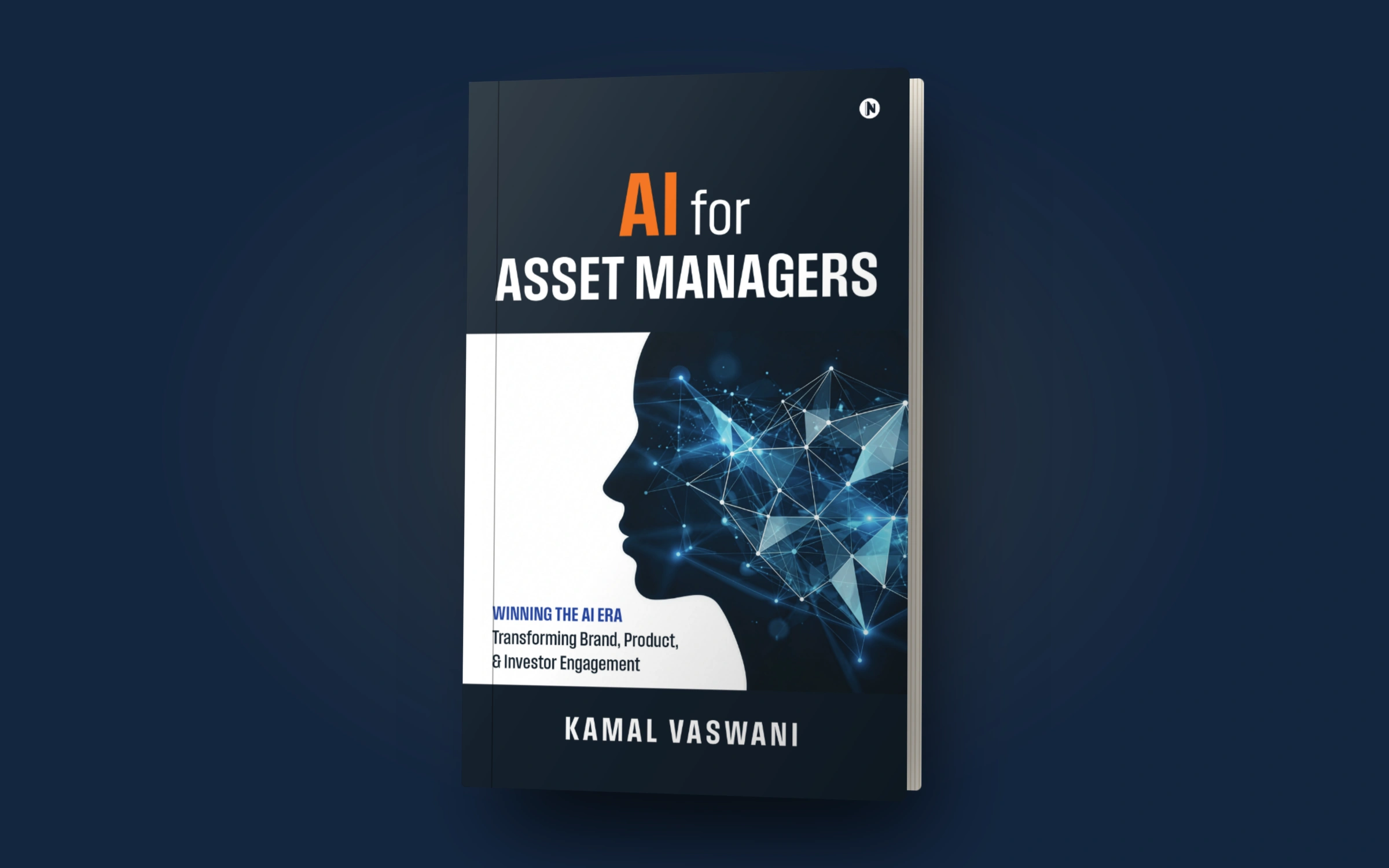
This is the AI advantage that AI for Asset Managers: Winning the AI Era is built around. Not AI as a way to bypass compliance. AI as a way to make compliance faster, more consistent, and more scalable — so that the marketing function can move at the speed the market demands without accumulating the regulatory risk that moving fast without governance inevitably creates.
The question every AMC CMO needs to answer
SEBI and AMFI will eventually publish specific guidance on AI in fund marketing. The regulatory direction globally — from the FCA in the UK to ESMA in Europe to MAS in Singapore — is consistently toward greater AI governance requirements in financial services communication, not fewer.
The AMCs that wait for that guidance before building their AI frameworks will spend the first six months after publication in reactive compliance mode — scrambling to retrofit governance onto AI deployments that were never designed for it.
The AMCs that build their frameworks now will spend those same six months refining a system that is already working — and pulling further ahead of the competitors who are still catching up.
The compliance landscape for AI in fund marketing is not a barrier to winning the AI era.
It is the terrain on which the winners will be decided.
The AMCs that learn to navigate it with precision, speed, and genuine strategic intent will not just survive the regulatory environment that is coming.
They will define it.
Kamal Vaswani is the author of AI for Asset Managers: Winning the AI Era, available on Amazon, Flipkart and Ingram. She is the founder of BYLAAR and the creator of the TRUST-AI™ framework.
 Written byKamal VaswaniFounder, BYLAAR · Author, AI for Asset Managers: Winning the AI Era